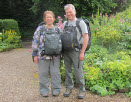
11th October - Hà Nội, 21°N 105°E, GMT+7
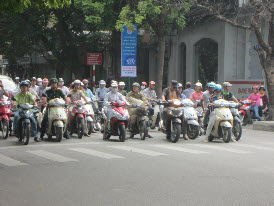 Hanoi: City of Motorbikes. Hanoi is a lovely city after China's giant cities with
their pollution and wide roads in a grid formation. Hanoi still keeps its centuries
old road pattern like many European cities. This does mean that it's harder to find
your way around and most of the roads are far too narrow for the traffic on them
but this is a large part of the fun of being here.
Hanoi: City of Motorbikes. Hanoi is a lovely city after China's giant cities with
their pollution and wide roads in a grid formation. Hanoi still keeps its centuries
old road pattern like many European cities. This does mean that it's harder to find
your way around and most of the roads are far too narrow for the traffic on them
but this is a large part of the fun of being here.
The roads are packed, mostly with scooters and small motorbikes, but the driving
here seems pretty safe, we’ve only see a couple of low speed bumps. Nobody looks
for a gap in the traffic - they just set off. It's up to everyone behind them to
cope with it. Crossing the road, like in China, just requires setting off slowly,
purposefully and warily and letting the traffic flow around you. Don't bother waiting
for a gap because it will never come, never step backwards once you’ve set off and
suppress the urge to run at all costs! Be especially wary of a green man if you see
one as there will still be plenty of vehicles crossing your path and they don't think
you've got right of way (in Japan it was all different - you could safely cross on
a green man with your eyes shut if the mood took you).
We need visas for India and hadn't been able to get them before we left the UK because
they only last 6 months. The plan had always been to get them in Hanoi. We filled
in the online Indian Visa forms and todlled off to the embassy. Unfortunately visa
applications are only accepted between 9 and 12. We did find out that the fee is
$63 each (why dollars? the Vietnam visa required dollars as well - what's wrong with
Vietnamese dong?). Go to a bank and then a bureaux de change trying to convert some
dong into dollars. Unfortunately, currency conversion here only works in one direction:
from any other currency into dong, never the other way round. They do tell us the
address of a place where it is possible. We get there and it looks a bit like someone's
house except the front room is packed with people with money in their hands. Someone
asks us what we want and directs us to the back room - more people, more wads of
dollars and dong, stacks of $10,000 in $100 bills on the mantelpiece. We say how
many dollars we want, are shown how much dong it will cost and then the guy disappears
with our money. Eventually (it was probably only a minute) he comes back with the
dollars and the change in dong. No security, no paperwork, no information on exchange
rates or fees, no questions asked. The place felt as though it was on, or possibly
just outside, the fringes of the law.
At the embassy the following morning we find that it takes 5 working days to process
the visa so it would be ready 3 days after we have left Hanoi. We ask if there is
any quicker way but it seems that even additional cash won't help. Despondent, we
leave the embassy and wonder where we will be able to get our visa...
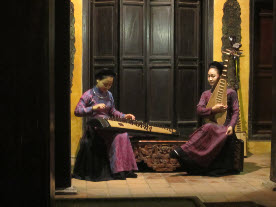 The memorial house is an example of how houses in Hanoi used to be - running a long
way back from the road with internal courtyards open to the sky. After our visit
we were asked if we wanted to come back that evening for a concert of traditional
Vietnamese, Ca Tru, music. We came back for the concert which was a little bit like
very free jazz, especially the guy with the small drum. It turns out that he isn't
really a musician but he represents a member of the audience in the house where the
music is being played. Three bangs on the drum is a sign for the musicians to get
on with it and start playing. Two taps on the side of the drum mean he thinks they
are playing well. This is all very well but he also joins in with random beats whenever
he feels like it.
The memorial house is an example of how houses in Hanoi used to be - running a long
way back from the road with internal courtyards open to the sky. After our visit
we were asked if we wanted to come back that evening for a concert of traditional
Vietnamese, Ca Tru, music. We came back for the concert which was a little bit like
very free jazz, especially the guy with the small drum. It turns out that he isn't
really a musician but he represents a member of the audience in the house where the
music is being played. Three bangs on the drum is a sign for the musicians to get
on with it and start playing. Two taps on the side of the drum mean he thinks they
are playing well. This is all very well but he also joins in with random beats whenever
he feels like it.
The museum of ethnology is fascinating. Although the Viet make up 86% of the population
the other 14% is split between another 53 ethnic groups scattered all over the country
but particularly in the mountains. The museum has examples of traditional houses
from different areas, a lot of them stilt houses with 'floorboards' made from bamboo
that has been 'unwound' to make it flat (just another of the endless uses for bamboo
- the museum has it used for cups, ladles, pipework, musical instruments, scaffolding,
spears and arrows and as a pole for the classic way of carrying two baskets over
your shoulder). Any fears about going straight through a floor designed for slim
Vietnamese people were unfounded.
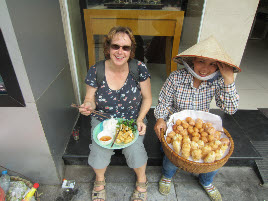 We've eaten street food a couple of times here, the same meal both times. The street
food vendor has the pole with two baskets setup. She has a wok and a burner in one
end and the ingredients and some tiny plastic stools in the other. You only get these
stools in infant schools in the UK, here they are everywhere - used for pavement
bars and restaurants. They seem far too small as you lower yourself on but they actually
work very well. We had fried tofu with noodles and a lime and chilli dip with some
kind of mint leaves. It is really tasty and costs less than £2. We’ve also tried
the doughnuts sold by the woman on the right but were less keen on these despite
our sweet teeth.
We've eaten street food a couple of times here, the same meal both times. The street
food vendor has the pole with two baskets setup. She has a wok and a burner in one
end and the ingredients and some tiny plastic stools in the other. You only get these
stools in infant schools in the UK, here they are everywhere - used for pavement
bars and restaurants. They seem far too small as you lower yourself on but they actually
work very well. We had fried tofu with noodles and a lime and chilli dip with some
kind of mint leaves. It is really tasty and costs less than £2. We’ve also tried
the doughnuts sold by the woman on the right but were less keen on these despite
our sweet teeth.