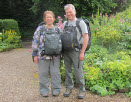


14th October -
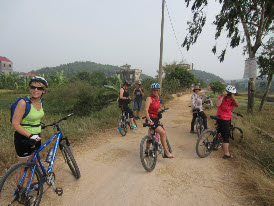 On Saturday we meet up with fellow travellers for 2 weeks organised cycling: 7 English
(plus the two of us), 2 Scottish, 2 Kiwis and 1 Canadian.
On Saturday we meet up with fellow travellers for 2 weeks organised cycling: 7 English
(plus the two of us), 2 Scottish, 2 Kiwis and 1 Canadian.
At the initial allocation of bikes and quick test ride we stand out by our lack of lycra and helmets but everyone is really friendly and no one has brought their own pedals or saddle with them (unlike another tour we have been on).
The 'stain and water repellant' coating on Phil's shorts is causing some problems.
As well as not letting water in it’s not letting any out either -
We cycle round on dykes beside the red river and have a lovely lunch at a local’s house in a village that took a long time to get to on the bus over a gradually deteriorating road surface.
 16th October -
Ha Long bay has recently been added to a ‘seven natural wonders of the world’ list
(there are quite a few of these lists and this particular one was decided by an online
poll rather than by some kind of expert group -
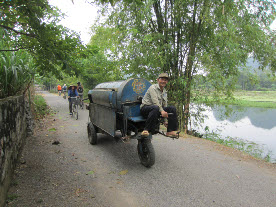 The next day we set off from the hotel in light rain. We have a lovely ride down
quiet roads and through villages until we reach two temples in the Hoa Lu area which
was the capital around 1050. Rice is being harvested and there is a threshing machine
every few hundred metres. I’m pretty sure the threshing machines were never meant
to be self-
The next day we set off from the hotel in light rain. We have a lovely ride down
quiet roads and through villages until we reach two temples in the Hoa Lu area which
was the capital around 1050. Rice is being harvested and there is a threshing machine
every few hundred metres. I’m pretty sure the threshing machines were never meant
to be self-
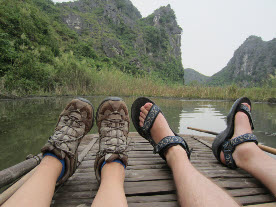 Afterwards we cycle a bit more then have an hour being rowed through more karst landscape
in sampans. It’s like Ha Long bay but this time the water is only a foot deep. Everyone
starts to use their life jackets as cushions when it becomes apparent that, in the
event of an emergency, the only skill you will require is to be able to stand up
and walk to the edge. We felt a bit sorry for the woman rowing our sampan as she
seemed to have got the short straw with our boat lower in the water than the others
but we also know that if we tried to row ourselves we could be moving in tight circles
for hours.
Afterwards we cycle a bit more then have an hour being rowed through more karst landscape
in sampans. It’s like Ha Long bay but this time the water is only a foot deep. Everyone
starts to use their life jackets as cushions when it becomes apparent that, in the
event of an emergency, the only skill you will require is to be able to stand up
and walk to the edge. We felt a bit sorry for the woman rowing our sampan as she
seemed to have got the short straw with our boat lower in the water than the others
but we also know that if we tried to row ourselves we could be moving in tight circles
for hours.
18th October -
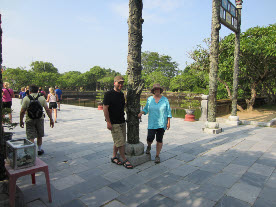 All aboard the Reunification Express! The sleeper train we are getting on to head
south to Hue stops for exactly four minutes in Ninh Binh. We have 15 people and 15
large bags to get on board in the correct carriage before the train sets off with
no concessions for tardiness. Luckily the extensive training we had had over the
previous days pays off and we all get on before the train starts moving. Everyone
is bit hyper after our successful boarding and most move to the buffet car to calm
down for a couple of hours. It's not as nice as the Russian sleepers but better than
the Indian ones. We actually got some sleep!
All aboard the Reunification Express! The sleeper train we are getting on to head
south to Hue stops for exactly four minutes in Ninh Binh. We have 15 people and 15
large bags to get on board in the correct carriage before the train sets off with
no concessions for tardiness. Luckily the extensive training we had had over the
previous days pays off and we all get on before the train starts moving. Everyone
is bit hyper after our successful boarding and most move to the buffet car to calm
down for a couple of hours. It's not as nice as the Russian sleepers but better than
the Indian ones. We actually got some sleep!
Hue is another ancient capital of Vietnam (there are dozens of them), it was active between 1802 and 1945. There is a citadel which is like a smaller version of Beijing's forbidden city. It was in good condition until the American's bombed it (a recurring theme) and now there are only foundations left for some of the buildings and bullet holes in the buildings that are still standing.
Went to a vegetarian restaurant called Lien Hoa for tea. Experienced the problem
we always have in vegetarian restaurants of too much choice (it's so easy when they
only have one vegetarian dish) so the waitress helped us out by pointing at 'Mixed
food -
When we got back we stopped at the cafe next to the hotel where they also sold memory cards as we were after a spare. The cafe owner didn’t have any big enough but said ‘two minutes’ and jumped on his motorbike. Two minutes later he returns with exactly the right card. It was a little more expensive than you’d pay normally but, with service like that, you do feel some obligation to buy.
Considering that our group is composed entirely of sensible grown-
21st October -
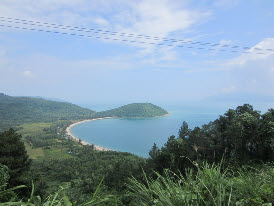 We got the bus to the top of the Hai Van pass (500m), the point that has traditionally
marked the division between the north and the south of Vietnam. There are some great
views from the pill boxes and fortifications beside the road. The van has brought
our bikes up earlier and we jump on them and cycle to the bottom (the sort of cycling
that everyone can enjoy). The road is quiet because there is a tunnel that now takes
all of the lorries and buses under the pass. The articulated lorries have large American-
We got the bus to the top of the Hai Van pass (500m), the point that has traditionally
marked the division between the north and the south of Vietnam. There are some great
views from the pill boxes and fortifications beside the road. The van has brought
our bikes up earlier and we jump on them and cycle to the bottom (the sort of cycling
that everyone can enjoy). The road is quiet because there is a tunnel that now takes
all of the lorries and buses under the pass. The articulated lorries have large American-
At the bottom of the pass we keep cycling until we get to China Beach -
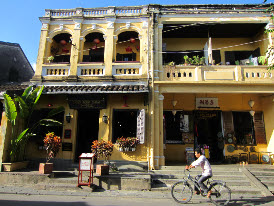 The centre of Hoi An could have been designed with tourists in mind with restaurant
/ tailor / massage / restaurant / tailor / travel agent down both sides of its three
central streets. While it is touristy that can also be very handy if you’re a tourist.
Lots of people get clothes made for them: measure today, fitting tomorrow, finished
the day after. Karen gets a silk top made that was ready 24 hours later and cost
about £20. Unfortunately it turns out it’s not the right colour to go with her new
trousers but you can’t have everything. It just means that she needs some more new
trousers.
The centre of Hoi An could have been designed with tourists in mind with restaurant
/ tailor / massage / restaurant / tailor / travel agent down both sides of its three
central streets. While it is touristy that can also be very handy if you’re a tourist.
Lots of people get clothes made for them: measure today, fitting tomorrow, finished
the day after. Karen gets a silk top made that was ready 24 hours later and cost
about £20. Unfortunately it turns out it’s not the right colour to go with her new
trousers but you can’t have everything. It just means that she needs some more new
trousers.
The relentless nature of the cycling holiday has taken its toll and Phil has a morning off while everyone else goes looking at local crafts. The last man making coracles in the village is over 80 but still puts on a show to explain how it’s done.
We have a couple of nice meals at Green Moss and the Cargo Club and a rush of fittings and adjustments to clothing just before we leave to go to...
 23rd October -
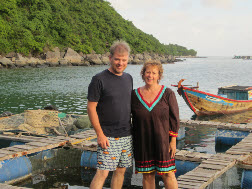
Up early for the flight to Nha Trang, bus to hotel, bus to quay, boat to island,
couple of hours snorkelling and looking at fish farm, back in the boat, quick shower,
out for something to eat, back to hotel, up early the next day for flight to Ho Chi
Minh City after less than 24 hours in Nha Trang. Tried the cheapest place in town
for dinner (Pho 24, think Little Chef with noodles) -
Most of the banknotes here are made from plastic with small transparent windows in
them. You might assume that this is to make them harder to forge but it also makes
sense when you forget you’ve put some money in the the pocket of your swimming trunks
-
25th October -
 Although Saigon was officially renamed Ho Chi Minh City (HCMC) in 1976 it’s still
commonly referred to as Saigon. The Vietnamese kicked the French out in 1954 but
they’ve hung on to the French things that they liked: several grand buildings in
the centre of town including City Hall, the Opera House and the Post Office; French
bread; French cuisine and the railways that the French built. It’s got quite a different
feel to Hanoi with wider roads and more cars.
Although Saigon was officially renamed Ho Chi Minh City (HCMC) in 1976 it’s still
commonly referred to as Saigon. The Vietnamese kicked the French out in 1954 but
they’ve hung on to the French things that they liked: several grand buildings in
the centre of town including City Hall, the Opera House and the Post Office; French
bread; French cuisine and the railways that the French built. It’s got quite a different
feel to Hanoi with wider roads and more cars.
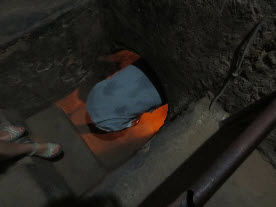
The Cu Chi tunnels northwest of Saigon were the headquarters of the Vietcong resistance
during the Vietnam war. As you walk around you see the invisible trap doors used
for access, the ‘ant hills’ used for ventilation and some examples of the types of
traps used around the entrances to stop unwanted visitors. They have enlarged a section
of tunnel so that bulky westerners can fit down them but it is still very claustrophobic.
The sounds of shooting from the attached firing range (fire an AK47 -
The rest of the cycling group leaves us on Friday the 26th. The self-
Next: Ho Chi Minh City